Quick answer: For most Florida backyards, pavers are the better long-term patio. They cost more up front, roughly 30% to 60% more than a plain concrete slab, but they flex with sandy soil and tree roots instead of cracking, they drain faster in summer downpours, and a damaged area can be fixed by lifting and resetting a few pavers. Concrete wins when the budget is tight, the area is simple and flat, and you are fine with the look of a slab.
Choosing between pavers and concrete is the first big decision in almost every patio project in Jacksonville, St. Johns and Ponte Vedra. Both can last for decades when they are built on a proper base. They just age very differently in Northeast Florida, where the soil is sandy, the water table is high and a summer storm can drop two inches of rain in an hour.
This guide compares the two side by side: cost, durability, heat, drainage, maintenance, resale value and HOA rules, so you can pick the best patio material for your home and budget.
Are pavers better than concrete for a patio in Florida?
In most cases, yes. A concrete patio is one rigid slab. When the ground under it settles, or a live oak root pushes up from below, the slab cracks, and the crack stays visible forever. A paver patio is made of hundreds of interlocking units set on a compacted base and a sand bed. That system can move slightly without breaking, which is exactly what Florida ground does.
Pavers also handle water better. Rain runs through the joints and off the edges instead of sheeting across a slab toward your house, and permeable pavers can absorb most of a storm on the spot. On lots with a limit on impervious surface, which is common in planned communities, that can be the difference between a patio that gets approved and one that does not.
Concrete still has real advantages. It is cheaper, faster to install and easy to keep clean. For a small, simple rectangle behind a rental, or a base for a future screened room, a well-built slab can be the smarter choice.
Paver patio vs concrete cost in Jacksonville
Prices change with size, access, site prep and the material you pick, so treat these as 2026 planning ranges for Northeast Florida, not quotes:
| Patio type | Typical installed cost per sq ft | What drives the price |
|---|---|---|
| Plain broom-finish concrete | $8 to $15 | Slab thickness, reinforcement, pump truck access |
| Stamped or colored concrete | $14 to $24 | Pattern, color, sealer, decorative borders |
| Concrete pavers | $16 to $30 | Paver style, base depth, cuts, borders and steps |
| Travertine pavers | $22 to $38 | Stone grade, thickness, sealing |
For a typical 300 sq ft backyard patio, that means roughly $2,400 to $4,500 for plain concrete and $4,800 to $9,000 for concrete pavers. Removing an old slab, grading a sloped yard, adding steps, seat walls or a fire pit all add to either option. If an existing slab has to go first, our concrete cutting and removal crew can break it out and haul it away before the new patio goes in.
The gap narrows over time. A cracked slab is usually patched (and the patch shows) or replaced. A section of pavers that sinks or gets damaged can be lifted, re-based and reset with the same pavers, so lifetime cost often ends up close.
How Florida weather tests a patio
Northeast Florida is hard on outdoor surfaces in a few specific ways:
- Sandy soil and a high water table. Sand shifts as it gets wet and dries out, and poorly compacted fill settles for years. Rigid slabs crack; interlocking pavers ride it out if the base is right.
- Heavy summer rain. Afternoon storms from June to September put a lot of water on a patio fast. Pavers shed and absorb it; a slab needs to be pitched perfectly away from the house or water pools against your foundation.
- Tree roots. Live oaks and laurel oaks are everywhere in Mandarin, San Marco and Riverside, and their roots lift slabs. Pavers can be lifted, the root dealt with, and the area reset.
- Heat and UV. Months of strong sun fade cheap colored concrete and dark pavers alike. Light colors and UV-stable sealers age best.
- Salt air near the Beaches. In Jacksonville Beach, Atlantic Beach and Ponte Vedra, salt spray can etch concrete surfaces over time; quality pavers and sealed travertine hold up well.
Durability and repairs: cracks vs loose pavers
Concrete cracks. Control joints cut every 8 to 10 feet tell it where to crack so the lines stay straight, but hairline cracks still appear, and settlement cracks can open wide enough to trip on. Repairs rarely match the original color.
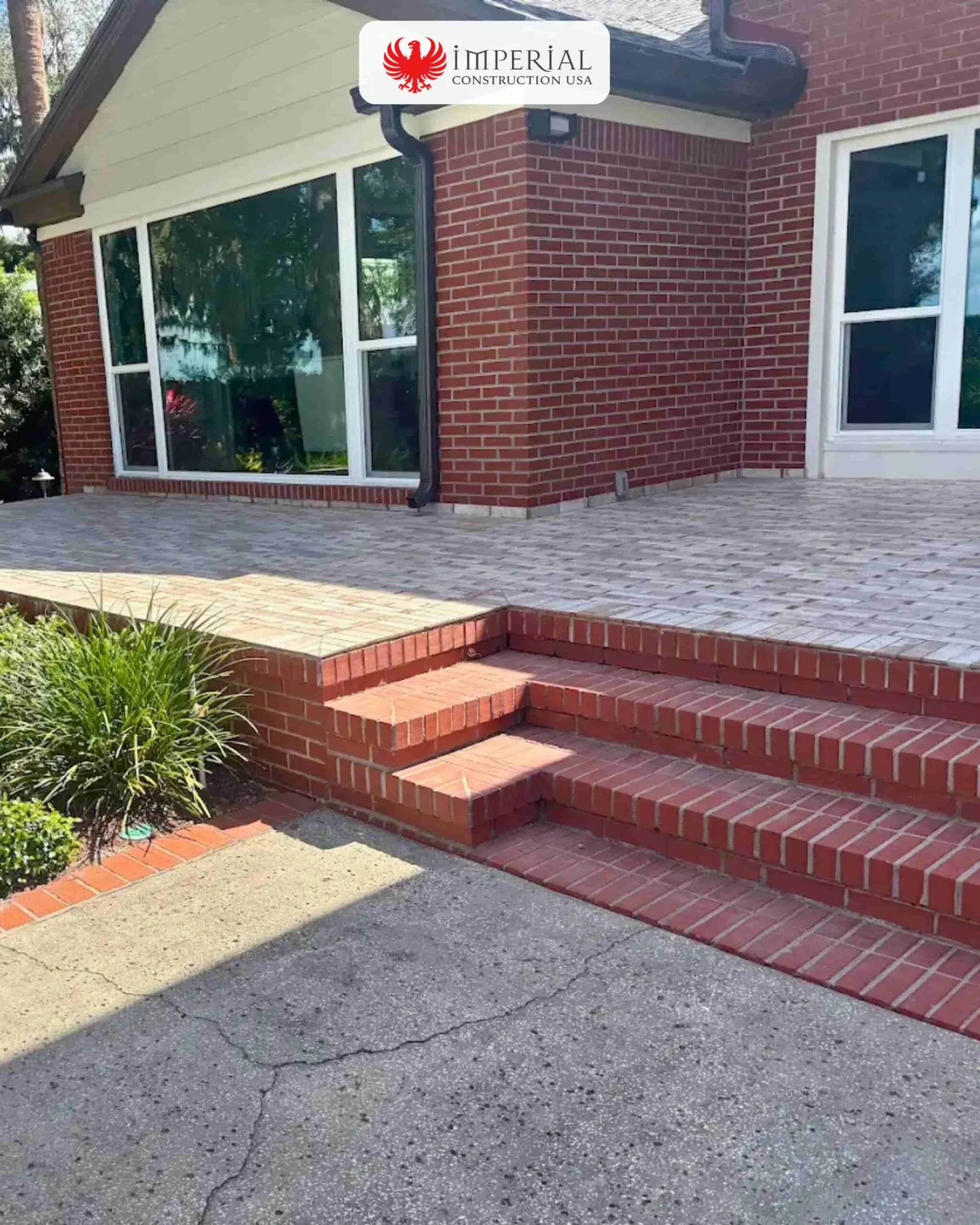
Pavers fail differently. If the base was skimped, individual pavers sink, rock or spread apart, and weeds and ants move into the joints. The good news is that every one of those problems is repairable without demolition. The key is the part you never see: a compacted base of crushed concrete or limestone, typically 4 to 6 inches thick for a patio, a one-inch bedding layer of sand, a solid edge restraint and polymeric sand in the joints. We explain each layer in our paver patio installation guide.
Looks, heat and slip resistance around the pool
Pavers come in dozens of shapes, colors and textures, from classic brick-look herringbone to large-format slabs and natural travertine, so you can match the house, add borders or mix patterns. Plain concrete is uniform gray; stamping and coloring help, but the surface can still look like a slab once it weathers.
For pool decks, comfort matters. Light-colored travertine and light concrete pavers stay noticeably cooler under bare feet than dark pavers or dark stamped concrete. Textured pavers also grip better when wet. If you seal a paver pool deck, ask for a sealer with a non-slip additive.
Maintenance: sealing, polymeric sand and pressure washing
| Task | Pavers | Concrete |
|---|---|---|
| Cleaning | Pressure wash on low pressure, then re-sand joints | Pressure wash as needed |
| Sealing | Every 2 to 3 years (optional, recommended near pools) | Every 2 to 3 years for stamped or colored concrete |
| Weeds and ants | Polymeric sand keeps most out | Only in cracks and joints |
| Repairs | Lift and reset the affected area | Patch or replace sections |
Mildew and algae grow on both surfaces in shady, damp yards, so plan on an annual wash in Florida either way.
Resale value and HOA rules
Buyers in Jacksonville tend to see pavers as an upgrade, the same way they see quartz countertops or a screened lanai. In communities like Nocatee, Durbin Crossing and the rest of St. Johns, pavers are often the expected finish, and many HOAs require architectural review approval for any new hardscape. Check your HOA guidelines for approved colors, materials and setbacks before you sign a contract, and ask your contractor to prepare the drawing for the submission.
Larger patios, retaining walls and anything tied into a structure can also need a building permit from the City of Jacksonville or St. Johns County. A licensed contractor should tell you up front; our guide on hiring a Florida contractor covers what to check.
Best patio material for Florida: our recommendation
| If you... | Choose |
|---|---|
| Want the longest-lasting patio and plan to stay | Concrete pavers |
| Have big trees near the patio | Pavers (easy to lift and reset) |
| Are building a pool deck | Light-colored travertine or concrete pavers |
| Need the lowest upfront cost | Plain broom-finish concrete |
| Plan to enclose the area later (sunroom, screen room) | A properly engineered concrete slab |
| Live in an HOA with hardscape rules | Pavers in an approved color |
Want to see both options priced for your yard? Our crew installs paver patios, pool decks and driveways across Jacksonville, St. Johns County and the Beaches, and we will tell you honestly when a slab makes more sense.

A licensed and insured general contractor based in Jacksonville, FL. Our own in-house crew remodels kitchens, bathrooms, floors, patios and decks across Duval, St. Johns, Clay and Nassau counties, with free written estimates and 10% off your first service. Meet the team.